Intended use and target users
NucleOSS Surgical Instruments are intended for use in the surgical application of NucleOSS dental implants indicated for the jaw treatment of edentulous and partially edentulous patients. NucleOSS Dental Implant burs and instruments are intended for use by dentists only.
Intended use: surgical instruments are used to prepare the implant site in the mandible or maxilla for NucleOSS Dental Implants, to insert the implant, to tighten and remove all screws.
Target patient population: persons with adult jaw structure for whom none of the contraindications to dental implantation apply. Target users: dentists licensed in dentistry.
For detailed information on NucleOSS Surgical Instruments, see the Surgical Manual, which can be downloaded from www.nucleoss.com/kaynaklar/download/.
NucleOSS Surgical Instruments must only be used with the appropriate surgical technique and with appropriate NucleOSS devices (that is, interacting instruments and implants). If these conditions are not fulfilled, the manufacturer will refuse to accept liability. Instruments may be hand-held, manually operated or, where applicable, attached to electrical equipment.
Instruments included
Components, with their device class (* Class Ir device, ** Class IIa device):
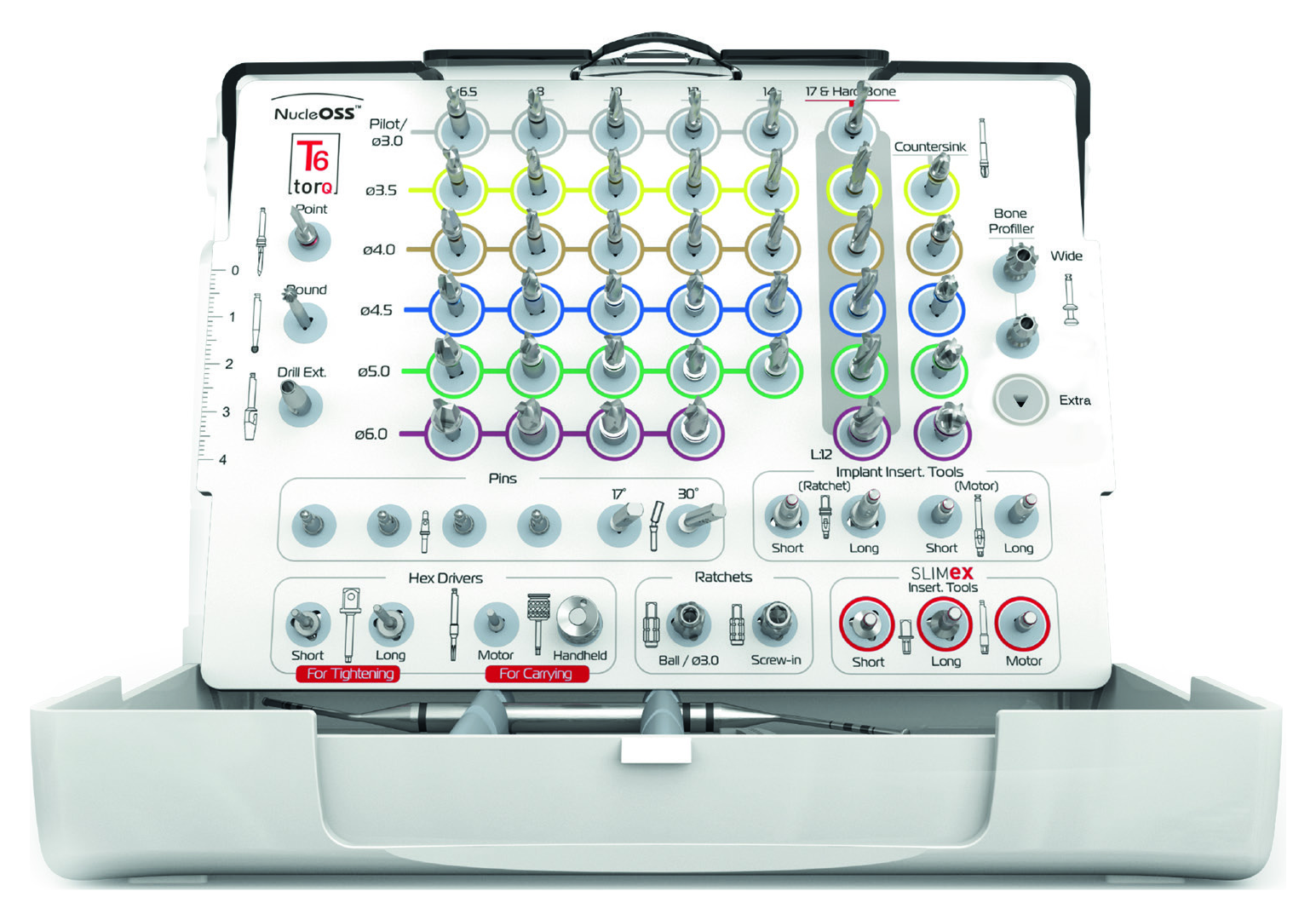
- Round Frez (**): when starting the operation, if the bone surface in the area where the implant will be placed is broken or irregular, it is used to provide the necessary corrections by filing.
- Point Drill (**): used to determine the place where the implant will be placed on the bone and for the comfortable progress of the next drill.
- Drill Extension (**): used to extend the drill length by approximately 16 mm in cases where the drill length is insufficient.
- Pilot Drills (**): used to open an implant slot in the jaw bone. Designed in 6 different lengths in accordance with the different size options of NucleOSS implants.
- Hard Bone Burs / Final Burs (**): hard bone burs expand the drilled slot by 0.2 mm, allowing the implant to move more easily in the slot and reduce the stress.
- Neck Expander Burs (**): designed for passive seating of the implant neck in the surgical field.
- Bone Profiler Burs (**): remove irregular bone in the neck area of the implant to prevent fracture of the abutment or attachment screw.
- Parallel Pins (*): used to control the parallelism with the side teeth in single implant treatment and parallelism between the implant sockets in multiple implant treatments.
- Transport-Clamping Piece (*): used for transporting the implant from the sterile tube to the surgical site and placing the implant.
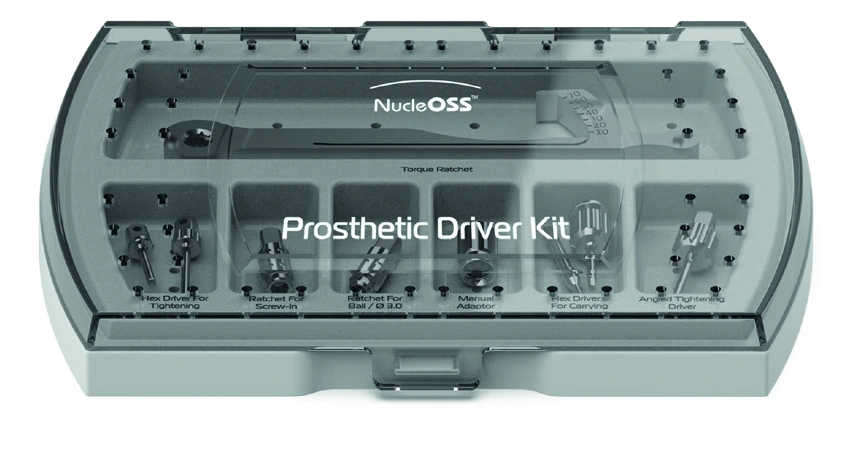
- Hex Key (*): used for fixation of healing components, prosthesis and impression taking parts.
- Torque Ratchet (*): used for tightening all abutments and screws to the torque values specified by NucleOSS in the product catalogues.
- Screwdriver (*): used for manual insertion or removal of screws, implant caps, healing caps, abutments and bodies in the NucleOSS system.
Note: all cutters are colour coded to indicate their diameter. Diameter and length information is engraved.
Contraindications
- High blood pressure, cardiovascular disease, diabetes, bone metabolism disorders, uncontrolled bleeding disorders, inadequate wound healing capacity, inadequate oral hygiene, serious internal medical problems, incomplete development of the upper and lower jaw, poor general health, uncooperative and unmotivated patients, drug, alcohol or smoking addiction, psychoses, functional disorders resistant to long-term treatment, xerostomia (dry mouth), granulocytopenia (lack of white blood cells), Ehlers Danlos syndrome, radiation therapy, osteoradionecrosis, weakened immune system, renal failure, organ transplantation, fibrous dysplasia, crohn’s disease, steroid, corticosteroid or anticonvulsant use, prophylactic antibiotics, creatinine, serum calcium, titanium allergy, uncontrolled endocrine disorders, anticoagulation drugs, haemorrhagic diathesis, bruxism, parafunctional habits, unfavourable anatomical bone conditions, uncontrolled periodontitis, temporo-mandibular joint disorders, treatable pathological diseases of the mandible or changes in the oral mucosa, pregnancy, breastfeeding, osteoporotic fracture, respiratory disease, thyroid or parathyroid diseases.
- Patients with active osteolytic, inflammation, diagnosed malignancy, nodular growths, tenderness, unexplained swelling of the head or neck, infectious conditions at the implant site.
- Unrealistic patient expectations.
- Unattainable prosthetic reconstructions.
- Inadequate training of the practitioner.
Warnings and precautions
Observance of precautions and warnings ensures safe handling and application.
- Use of the NucleOSS brand and sale of NucleOSS Dental Implant System products are restricted to NucleOSS and its business partners.
- NucleOSS Surgical Instruments are supplied to the market as non-sterile. These instruments must be cleaned and sterilised according to these instructions before each use.
- All models in the NucleOSS Dental Implant system must be performed according to NucleOSS Surgical and Prosthetic protocols. Surgeons are advised to review the product specific surgical technique before operating. Surgeons should also be fully familiar with the instrument, the method of application and the surgical technique. The correct use of the instruments is critical to the success of the operation.
- NucleOSS Surgical Instruments should only be used in conjunction with appropriate NucleOSS devices (that is, interactive instruments and implants). NucleOSS has not tested compatibility with devices supplied by other manufacturers and assumes no responsibility in such cases.
- NucleOSS Surgical Instruments are subject to wear with repeated use beyond the recommended number of times (15 times). Inspect instruments before use to verify condition and do not use if damaged or worn.
- Instrument breakage or damage can occur when surgical instruments are subjected to loads and/or angles inappropriate for a particular application, excessive speeds, dense bone or misuse. Lateral pressure from the bur can cause the bur to break. Verify that the bur is securely locked to the handpiece before drilling.
- Depending on the surgical technique, refer to the colour coding and informative laser marking on the interactive instruments to ensure proper use of the instruments.
- They should be kept out of the reach of children.
- Inform the patient before and after the surgical operation.
- The patient’s health condition must be suitable for the operation.
- Use drills suitable for the diameter and length of the implant.
Points to consider
- Failure to observe the indications for use and surgical procedures may result in failure. It is strongly recommended that NucleOSS surgical instruments are only used in conjunction with compatible NucleOSS implant systems and prosthetic components.
- To prevent the risk of interpersonal infection when using the product, dentists and auxiliary personnel must wear appropriate personal protective equipment (PPE). No procedures should be performed without gloves and a mask.
- Failure to recognise actual drill lengths according to radiographic measurements may result in permanent injury to nerves or other vital structures. For mandibular surgery, drilling beyond the targeted depth may cause permanent numbness of the lower lip and chin tip or may cause haemorrhage at the floor of the mouth.
- NucleOSS Surgical Instruments are to be used for their intended use only. The surgical technique provides the method of application for basic use. The decision to use an instrument should be based on sound medical judgement that takes into account factors such as surgical application, physical and mechanical properties. If more comprehensive information on instrument mechanics or method of use is required, the user is encouraged to contact NucleOSS representatives.
Before surgery: a clinical and radiological examination of the patient should be performed preoperatively to determine the patient’s suitability for treatment and to determine his/her psychological and physical condition.
Special attention should be paid to patients with localised or systemic factors that may interfere with the bone or soft tissue healing process or the osseointegration process (for example smoking, poor oral hygiene, uncontrolled diabetes, facial radiotherapy, infections in the lateral tooth or bone, bisphosphonate therapy).
The device has not been evaluated in paediatric/adolescent patients and is not recommended for use in children.
Surgery: all components, devices and instruments used during the procedure should be kept in good condition and care should be taken to ensure that instrumentation does not damage implants or other components.
After surgery: to ensure a long-term treatment outcome, it is advisable to ensure regular comprehensive patient follow-up after implant treatment and to provide the necessary information about proper oral hygiene.
Residual risks and side effects
The use of NucleOSS surgical instruments is part of invasive treatment which may be associated with typical side effects such as inflammation, infection, bleeding, haematoma, pain and swelling.
Depending on the location, in rare cases it may lead to perforation or fracture of bone, perforation of soft tissue spaces and adjacent tissues, nerve injuries, perforation of bone plates, sensory disturbances.
The side effects described are not specific to NucleOSS Surgical Instruments and can be observed with any surgical instrument. In case of complications related to the surgical instruments used, contact info@nucleoss.com.
Materials
NucleOSS surgical set components are made of stainless steel and titanium alloyed Ti6Al4V according to the ISO 5832-3 standard.
The surgical set (box) is made of highly impact-resistant plastic materials suitable for autoclave sterilisation.
Compatibility and Basic UDI-DI
The instruments should only be used with appropriate NucleOSS devices (interactive instruments and implants). Compatibility with devices from other manufacturers has not been tested by NucleOSS.
Basic UDI-DI codes for the devices described in these instructions:
| Product group | Basic UDI-DI code |
|---|---|
| Class 1 Accessories | 869938335C1rY3 |
| Surgical Set Container | 8699383352HZ |
| Surgical Instruments | 8699383353J3 |
| Reference | Description |
|---|---|
| 869938335C1rY3 | Basic UDI-DI — Class 1 Accessories |
| 8699383352HZ | Basic UDI-DI — Surgical Set Container |
| 8699383353J3 | Basic UDI-DI — Surgical Instruments |
Procedure
- According to the surgical techniques, the slot is first opened using Round and Point drills, which are the initial drills. Then Pilot drills, Hard Bone drills and Final drills, which are osteotomy drills, are used to prepare the socket in accordance with the implant selected for the patient. Bone quality should be taken into consideration in drilling operations. Refer to the Prosthetic Manual or Surgical Manual for the recommended drilling sequence according to bone quality.
- NucleOSS Surgical Instruments are designed in different colours compatible with different implant diameters. The colour code table (Table 1) shows which diameter of implant the surgical instrument is compatible for use with.
- In order to prevent overheating, an in-out drilling movement is required to be applied throughout the osteotomy while preparing the area.
- To avoid impingement at the apex, all drills are advanced 1 mm deeper than the implant placement distance. Observe this distance when drilling near anatomical structures.
- The drilled slot can be checked with a depth gauge.
- Neck expander drills are used to ensure passive seating of the implant in the created socket. All burs are designed for motorised use.
- Implants are ideally placed at low speed using the surgical motor. After placement, the implant is tightened using a maximum insertion torque of 30 Ncm.
- Guidelines for the use of NucleOSS Dental Implant System drills and surgical instruments are detailed in the NucleOSS Surgical Manual (https://www.nucleoss.com/kaynaklar/download/).
| Colour code | Meaning of colour code |
|---|---|
| Red | Indicates that it is a point drill. |
| Yellow | Indicates that it is used for Ø 3.5 mm implants. |
| Brown | Indicates that it is used for Ø 4.0 mm implants. |
| Green | Indicates that it is used for Ø 4.1 or 5 mm implants. |
| Blue | Indicates that it is used for Ø 4.5 mm implants. |
| Purple | Indicates that it is used for Ø 4.8 or 6 mm implants. |
Torque
The only torque value given here is a maximum insertion torque of 30 Ncm, used to tighten the implant after placement. Abutments and screws are tightened with the torque ratchet to the torque values specified by NucleOSS in the product catalogues.
| What | Torque | Note |
|---|---|---|
| Maximum insertion torque, implant tightened after placement | 30 Ncm | For abutments and screws, see the torque values in the NucleOSS product catalogues. |
Cleaning and disinfection (manual)
NucleOSS recommends timely cleaning of non-sterile, reusable instruments after the point of use using the following procedures. Due to differences in conditions and environments, the user has the ultimate responsibility for implementation and verification of procedures to achieve cleanliness.
Cleaning:
- Rinse the soiled instrument under warm, running tap water (22°-43° C) for at least two minutes. Remove coarse dirt using a soft bristle brush or a clean, soft, lint-free cloth. Never use metal brushes or steel wool for cleaning.
- Prepare an enzymatic cleaning solution using concentrated Enzymatic Presoak according to the manufacturer’s instructions (0.5% Neodisher MediZym solution in tap water at 30°C ± 3°C).
- Soak the instrument in the freshly prepared enzymatic cleaning solution for 20-25 minutes.
- The internal channels can be flushed with the cleaning solution using a flushing needle connected to a syringe. Check the channels for residual dirt and/or debris.
- Remove the device from the cleaning solution and rinse thoroughly with warm, running tap water (22° - 43° C) for at least one minute.
- Remove the device from the rinsing solution and rinse thoroughly with warm reverse osmosis or distilled water for at least one minute. After rinsing, visually check whether any residue has been removed from the device. If debris remains, use a syringe to rinse the device or repeat the rinse until the debris is removed.
- Dry the device using a clean, soft, lint-free cloth or clean compressed air. Visually inspect the device; no visible dirt should remain on the device. If dirt remains, repeat the cleaning procedure described above.
Note: thorough drying of the instruments prevents corrosion due to mineral content, condensate and residues.
Disinfection:
- Prepare a bath with Cidex Opa at a minimum concentration of 0.3% as specified in the detergent manufacturer’s instructions and at a temperature of 20°C (68°F) and immerse the devices for at least 12 minutes. Ensure that all surfaces are wetted with the disinfection solution.
- Flush the internal channels with the disinfecting solution at least three times using the flushing needle connected to a syringe.
- Rinse the devices thoroughly with distilled or sterile water for at least 1 minute. Repeat this step two more times for a total of three rinses. Do not reuse the water. Always use fresh water for each rinse.
- Dry the instruments using medical compressed air and clean, lint-free disposable cloths.
- Before starting sterilisation, inspect all instruments after cleaning/disinfection for visible dirt, corrosion, damaged surfaces and contamination and separate damaged ones.
- If necessary, repeat the complete manual cleaning and disinfection processes.
Sterilisation
NucleOSS does not accept any responsibility for devices initially delivered as non-sterile, regardless of who or by what method performed the sterilisation. Due to differences in conditions and environments, the user has the ultimate responsibility for the implementation and verification of procedures to achieve sterility. Non-sterile surgical instruments must not be used under any circumstances.
- Place properly cleaned and dried instruments in the designated slots inside the surgical set box. The surgical set is made of highly impact-resistant plastic materials suitable for autoclave sterilisation. In clinical autoclaves, the parts can be sterilised in one piece without having to be removed from the box.
- Place the surgical set container in the autoclave bag.
- Place the surgical sets in the steam steriliser, sterilise for 4 minutes on a 132°C pre-vacuum cycle with a drying time of 20 minutes.
- After the cycle is complete, remove the surgical sets from the steriliser and place the tray on a padded surface to prevent condensation during cooling.
- Note: do not stack the boxes during the sterilisation process, as this may affect the sterilisation efficiency.
- Note: sterilisation procedures have been validated in accordance with the applicable international standard ISO 17665-1.
- Note: the manufacturer’s instructions for use for all detergents/cleaning solutions and/or equipment and accessories used for cleaning and disinfecting the devices must be strictly followed.
Storage and disposal
After sterilisation, the surgical sets must be stored in a dry and dark place.
Disposal of the device must comply with local regulations and environmental requirements, taking into account different levels of contamination. Hazardous waste from contaminated devices or sharps must be disposed of in appropriate containers that meet specific technical requirements.
Patient information and clinical benefit
- The patient should be informed about contraindications, warnings, precautions, side effects and complications of NucleOSS dental implants.
- There is no residue, leakage or harmful residue on the surface of the device that could harm the user or the patient.
- The surgical site should be kept clean before and after the operation. The patient should be well informed about the cleanliness of the surgical site.
- The implanted area should not be exposed to load with chewing movement in the early period.
- For detailed information, refer to the Patient Information Booklet (https://www.nucleoss.com/hastaya-ozel/).
Expected clinical benefit: patients can expect to have one or more missing teeth replaced and/or crowns restored to restore chewing function as a benefit of treatment.
Reporting serious adverse events and safety summary
With the launch of the European Database for Medical Devices, a summary of safety and clinical performance for NucleOSS surgical instruments will be available at https://ec.europa.eu/tools/eudamed.
For the patient, user or third party in countries with Regulation 2017/745/EU on Medical Devices: if a serious adverse event occurs during or as a result of the use of this device, notify the manufacturer and your national competent authority. Manufacturer contact for reporting: NucleOSS, e-mail info@nucleoss.com. See the full instructions (PDF) for the web address.
Symbols
These symbols are used on all NucleOSS products. See the full instructions (PDF) for the symbol graphics.
- Product Catalogue Number
- Authorised representative
- Product Lot Number
- Read the operating instructions
- Unique device identifier
- Manufacturer
- Do not use if the packaging is damaged
- Prescription use only
- Medical device
- Non sterile
- Importer
- Warnings
- Producer country
- Model number
- Distributor
- CE marking is the manufacturer’s declaration that the product meets the requirements of the applicable EC legislation. Where applicable: the identification number of the Notified Body will follow this symbol.
- Contains hazardous substances (7440-02-0, Ni)